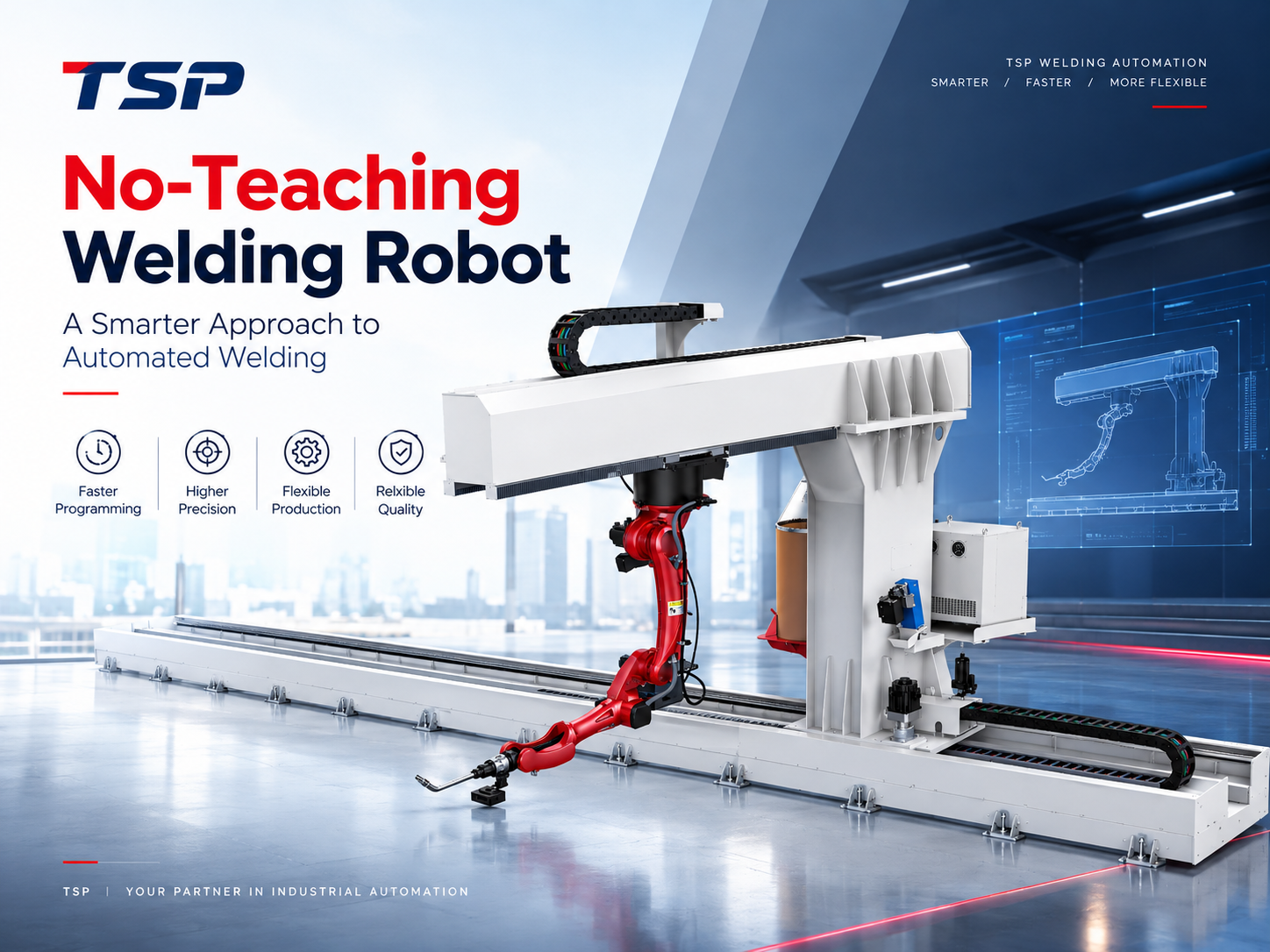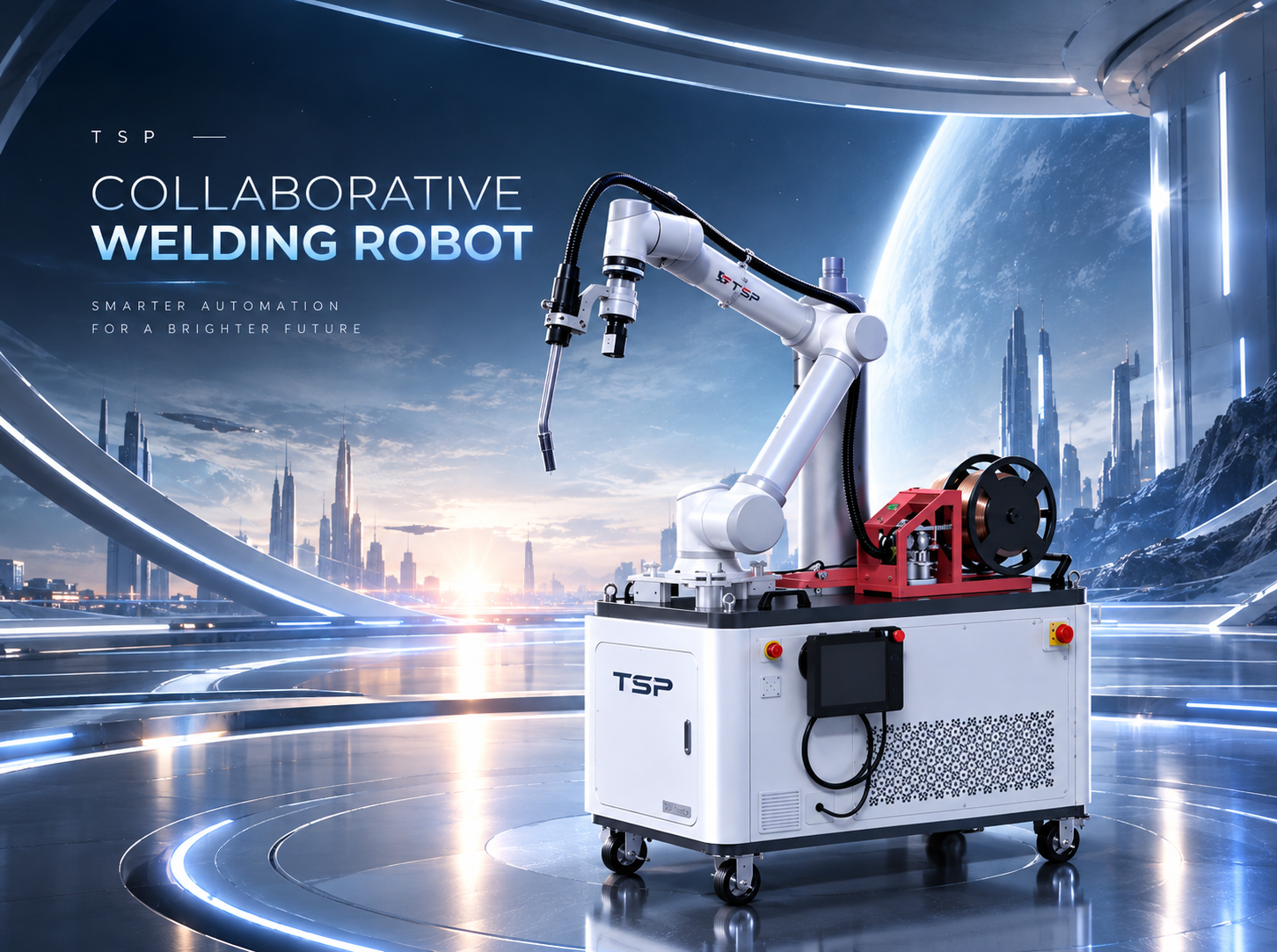






As manufacturing industries continue to embrace automation, collaborative welding robots are becoming an increasingly practical solution for improving welding consistency, production flexibility, and operational efficiency.
At TSP, we focus on industrial equipment and automation solutions designed to support manufacturers with evolving production requirements. Our collaborative welding robot solutions are intended to help businesses explore more flexible approaches to welding automation, particularly for repetitive welding tasks and production environments that require frequent product changes.
Unlike some conventional welding automation systems designed for dedicated production lines, collaborative welding robots can offer a more adaptable approach when the application, programming method, tooling, and safety configuration are properly selected.
So, where can TSP collaborative welding robot solutions be applied, and what should manufacturers consider before introducing welding automation?
1. Metal Fabrication and Sheet Metal Processing
Metal fabrication is one of the key application areas for collaborative welding robots. Manufacturers frequently need to weld metal frames, brackets, enclosures, cabinets, supports, and other fabricated components.
These tasks often involve repetitive welding paths and consistent quality requirements. A properly configured collaborative welding robot can repeatedly execute programmed movements, helping manufacturers establish more standardized welding procedures.
Typical applications include:
- Sheet metal cabinets and electrical enclosures
- Metal frames and structural components
- Brackets, supports, and mounting parts
- Custom metal products and fabricated assemblies
For workshops producing different products in small or medium batches, TSP collaborative welding robot solutions can be considered as part of a flexible welding workstation. Depending on the selected configuration, operators may switch between welding programs and adjust process parameters for different workpieces.
This approach can help manufacturers reduce repetitive manual work while maintaining greater consistency across similar welding tasks.
2. Automotive Parts and Components
The automotive supply chain requires consistent welding quality, repeatable processes, and efficient production workflows.
Collaborative welding robots can support the production of suitable automotive metal components, especially where flexibility and repeatability are important.
Potential applications include:
- Metal brackets and mounting components
- Seat frames and structural subassemblies
- Exhaust system components
- Small metal assemblies and fixtures
By repeating programmed welding paths, robotic welding systems can help maintain consistent weld placement and reduce operator fatigue during repetitive work.
When evaluating a TSP collaborative welding robot for automotive component production, manufacturers should consider material type, component geometry, welding process, production volume, and required cycle time.
For high-volume automotive production requiring extremely short cycle times, conventional industrial robots or dedicated automated welding lines may remain the more appropriate choice.
3. Agricultural Machinery and Construction Equipment
Agricultural machinery and construction equipment often contain welded frames, support structures, brackets, and mechanical assemblies.
These components may vary in size and geometry, making production flexibility an important consideration for manufacturers handling multiple equipment models.
Collaborative welding robot solutions may be suitable for selected applications where repeatable welding is required without building a highly specialized production line for every product.
Typical applications include:
- Equipment frames and support structures
- Metal brackets and connecting components
- Machine housings and protective structures
- Small and medium-sized welded assemblies
For manufacturers producing different machinery models, a flexible welding setup can help simplify production changes and improve the utilization of welding equipment.
For thick materials and heavy-duty structural welding, the robot’s payload, working reach, welding power source, positioner, and fixture design must be carefully evaluated before selecting a suitable TSP solution.
4. Metal Furniture, Shelving, and Display Products
Metal furniture and storage products frequently involve repeated welding operations across similar components. Examples include chair frames, table legs, shelving systems, display racks, and metal bed frames.
These products can be suitable for welding automation when manufacturers need consistent weld placement and repeatable production processes.
A TSP collaborative welding robot solution may be considered for applications such as:
- Metal furniture frame welding
- Storage racks and shelving systems
- Metal bed frames and support structures
- Commercial display stands and racks
- Other repetitive metal fabrication tasks
With appropriate programming and workpiece positioning, manufacturers can reduce repetitive manual welding tasks and establish more standardized operating procedures.
For products with visible weld seams, welding parameters, joint preparation, fixture accuracy, and finishing requirements remain essential to achieving the desired appearance.
5. Electrical Cabinets and Industrial Enclosures
Electrical cabinets, control boxes, and industrial enclosures often contain multiple sheet metal components that need to be joined accurately.
Collaborative welding robots can support suitable welding operations involving cabinet frames, mounting structures, panels, and other metal assemblies.
Potential advantages include more consistent weld placement, repeatable operation, and reduced dependence on continuous manual welding for repetitive tasks.
When considering a TSP collaborative welding robot for enclosure production, manufacturers should evaluate sheet thickness, welding distortion, joint accessibility, and surface finish requirements.
A suitable automation configuration should match the actual workpiece geometry and the quality standards required by the final product.
6. Small-Batch and Customized Manufacturing
One of the main reasons manufacturers consider collaborative welding robots is the need for greater flexibility in production environments where product specifications change frequently.
Traditional automated welding systems can deliver high productivity, but dedicated fixtures and complex programming may be less economical for certain low-volume applications.
Collaborative welding robot solutions can be worth evaluating for manufacturers producing customized components, multiple product variations, and small production batches.
Potential applications include:
- Small-batch and multi-variety manufacturing
- Customized metal components
- Prototype production
- Frequent product changeovers
- Flexible welding workstations
Depending on the programming method and system configuration, operators may switch between qualified welding programs for different workpieces. This can help manufacturers respond to changing orders while maintaining more standardized welding procedures.
The actual changeover time depends on the robot system, programming method, fixture arrangement, and workpiece complexity.
For businesses exploring flexible welding automation, TSP can be a starting point for discussing the requirements of the intended application and identifying a suitable equipment configuration.
7. How TSP Collaborative Welding Robot Solutions Can Support Production
The value of collaborative welding automation goes beyond automating the movement of a welding torch. When properly integrated into a production workflow, it can help address several common manufacturing challenges.
More consistent welding processes
Programmed movements and controlled welding parameters can help produce repeatable welds across similar workpieces. Actual weld quality still depends on joint preparation, material condition, process settings, and inspection.
Reduced repetitive manual work
Automating suitable repetitive welding tasks can reduce the physical demands placed on operators and allow skilled workers to focus on setup, inspection, and more complex operations.
Flexible production arrangements
Depending on the selected system, different workpieces and welding programs may be accommodated within the same workstation.
More standardized operating procedures
Stored programs and documented process parameters can help manufacturers establish repeatable procedures and improve production management.
Potential productivity improvements
Robotic operation can reduce the time required for certain repetitive tasks. Overall productivity depends on welding speed, loading and unloading, setup time, downtime, and the amount of manual intervention required.
The actual benefits of a TSP collaborative welding robot should therefore be evaluated against the manufacturer’s specific workpieces, production targets, and workflow.
8. Collaborative Welding Robots vs. Traditional Industrial Welding Robots
Collaborative welding robots and traditional industrial welding robots serve different production requirements. The most suitable solution depends on the application rather than the robot category alone.
| Factor | Collaborative Welding Robot | Traditional Industrial Welding Robot |
|---|---|---|
| Typical focus | Flexible production and selected repetitive welding tasks | High-throughput and specialized production |
| Deployment | May offer flexible integration in suitable applications | May require more extensive cell integration |
| Product changes | Can be convenient with appropriate programming and fixtures | Efficient when programs and fixtures are optimized |
| Workspace | Often designed for flexible workstation layouts | Frequently integrated into dedicated cells or production lines |
| Safety | Requires application-specific risk assessment and safeguards | Requires application-specific risk assessment and safeguards |
| Best fit | Flexible manufacturing and selected small-to-medium production tasks | High-volume, high-speed, or complex automated welding |
Importantly, the term “collaborative” does not mean that every welding application is safe for direct human-robot interaction without protective measures.
Welding introduces hazards such as arc radiation, heat, fumes, sparks, and moving equipment. A complete risk assessment and suitable safeguards are necessary for every installation, including systems using collaborative robots.
9. How to Choose the Right Collaborative Welding Robot
Before investing in a collaborative welding robot, manufacturers should evaluate the complete welding application rather than selecting equipment based only on price or payload.
Key considerations include:
Workpiece material and thickness: Different materials and thicknesses require appropriate welding processes, power sources, and parameter settings.
Workpiece dimensions and welding reach: The robot must reach all required joints while maintaining suitable torch angles and access.
Welding process: MIG/MAG, TIG, and other welding processes have different equipment requirements and application characteristics.
Programming method: Confirm whether the system uses teach-pendant programming, guided teaching, offline programming, or another method, and verify the functions supported by the selected model.
Fixture and positioning requirements: Accurate fixturing is essential for repeatable welding. Positioners may be necessary for more complex assemblies.
Production volume and cycle time: Evaluate whether the system can meet the required output, including the time needed for loading, unloading, and product changeovers.
Safety and compliance: Consider the complete workstation, including the robot, welding equipment, fixtures, surrounding workers, fumes, electrical systems, and applicable local standards.
Testing representative workpieces is often an effective way to determine whether a collaborative welding robot is suitable for a specific manufacturing process.
At TSP, we recommend evaluating the actual application requirements before deciding on an automation configuration. This helps ensure that the selected solution aligns with the workpiece, production goals, and operating environment.
Conclusion: Explore Collaborative Welding Automation with TSP
Collaborative welding robots have potential applications across metal fabrication, automotive components, agricultural machinery, metal furniture, electrical enclosures, and customized manufacturing.
Their value lies in combining repeatable robotic welding with flexible production arrangements. For manufacturers dealing with repetitive welds, changing product specifications, and the need for standardized processes, collaborative welding automation can be a practical step toward more efficient manufacturing.
However, the right solution depends on the workpiece, welding process, production targets, programming requirements, and safety considerations.
TSP is committed to supporting manufacturers with industrial equipment and automation solutions for evolving production needs.
If you are exploring collaborative welding robots for your factory, contact TSP to discuss your workpieces, welding requirements, and production goals. Our team can help you explore a suitable collaborative welding solution for your application.
TSP — Your Partner in Welding Automation.